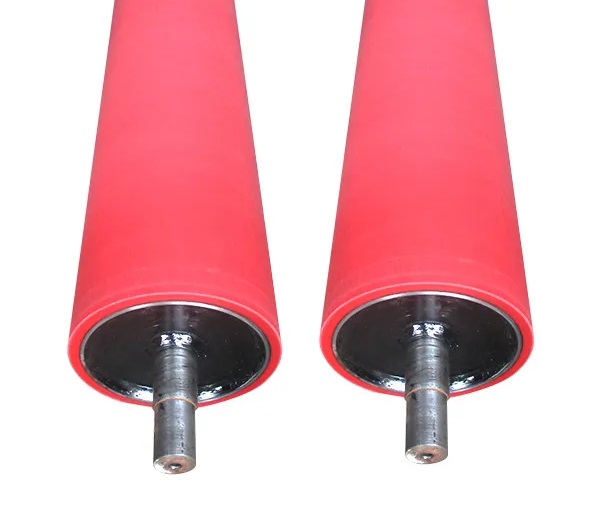
When plant managers and maintenance engineers specify elastomer-covered rollers, the decision almost always comes down to two material families: synthetic vulcanized rubber (such as Nitrile, Neoprene, EPDM, or Silicone) or liquid-cast Polyurethane (PU).
While both provide a resilient, non-marring surface that protects web substrates, their mechanical durability, load capacity, and chemical resistances differ substantially. Here is how to evaluate them.
1. Abrasion Resistance & Mechanical Wear
In high-abrasion environments—such as conveying corrugated cardboard, sheet metal pulling, paper slitting, or glass handling—Polyurethane consistently outperforms rubber by a factor of 3 to 5.
Standard DIN 53516 abrasion tests show that polyurethane loses significantly less volume under abrasive friction. Where a synthetic rubber roller might require regrinding every 3 to 4 months due to grooving or wear tracks, a quality cast PU roller typically runs for 12 to 18 months before service is needed.
2. Load-Bearing Capacity & Flat-Spotting Resistance
Under heavy static or dynamic nip pressures, rubber compounds exhibit high hysteresis and creep. If a rubber nip roller remains under clamp pressure during an overnight line stoppage, it often develops a permanent "flat spot" that causes web bounce upon restart.
Polyurethane rollers possess significantly higher compressive strength and modulus of elasticity. They resist cold flow and return to their true cylindrical profile almost instantly, making them the superior choice for high-pressure laminating, steel sheet coil feeding, and heavy conveyor pinch rolls.
3. Hardness Range & Shore Durometer Versatility
- Rubber Compounds: Typically formulated between 25 Shore A to 95 Shore A. Rubber is ideal for very soft, compliant applications (e.g., ink transfer, squeeze dewatering, and fragile film nips).
- Polyurethane: Spans a broad spectrum from 60 Shore A up to 75 Shore D (approaching the hardness of structural nylon while retaining elastomeric resilience).
4. Head-to-Head Engineering Comparison Table
| Performance Parameter | Vulcanized Rubber (NBR / EPDM) | Cast Polyurethane (PU) |
|---|---|---|
| Abrasion Resistance | Moderate to Good | Outstanding (3x–5x vs Rubber) |
| Load / Compression Capacity | Moderate (Risk of flat spotting) | Exceptional (High load, no creep) |
| Cut & Tear Resistance | Moderate | Superior (Resists metal burrs) |
| Max Continuous Temperature | 120°C – 150°C (Silicone up to 220°C) | 80°C – 90°C Max |
| Wet Hydrolysis Resistance | Excellent (EPDM / Neoprene) | Ether grades good; Ester grades vulnerable |
| Solvent / Oil Resistance | Excellent with NBR | Excellent with oils/fuels; vulnerable to ketones |
| Initial Upfront Cost | Lower Initial Capital Cost | Moderate to Higher Initial Cost |
| Total Cost of Ownership (TCO) | Higher due to more frequent regrinding | Lowest across high-wear duty cycles |
5. When Should You Choose Rubber?
Choose vulcanized rubber rollers if:
- Your operating temperature exceeds 90°C (e.g., hot lamination, curing ovens, Corona treaters).
- You need very soft compliance below 60 Shore A for ink distribution or delicate tissue wiping.
- The roller operates in continuous wet water baths or steam (EPDM rubber excels here).
- Initial procurement budget is constrained and wear levels are low to moderate.
6. When Should You Choose Polyurethane?
Choose cast polyurethane rollers if:
- You process sharp-edged materials (slitted steel sheet, glass sheets, heavy cartons) that easily gouge rubber.
- You experience frequent flat spots on rollers left under nip load during shutdowns.
- Downtime cost for roller replacement is high, making extended life paramount.
- Heavy radial loads require non-marking traction wheels or feed rollers.
Need an Application Analysis for Your Machine?
Send us your current roller wear patterns or operating drawings. Our engineering team will calculate whether synthetic rubber or cast PU provides the longest operational life.