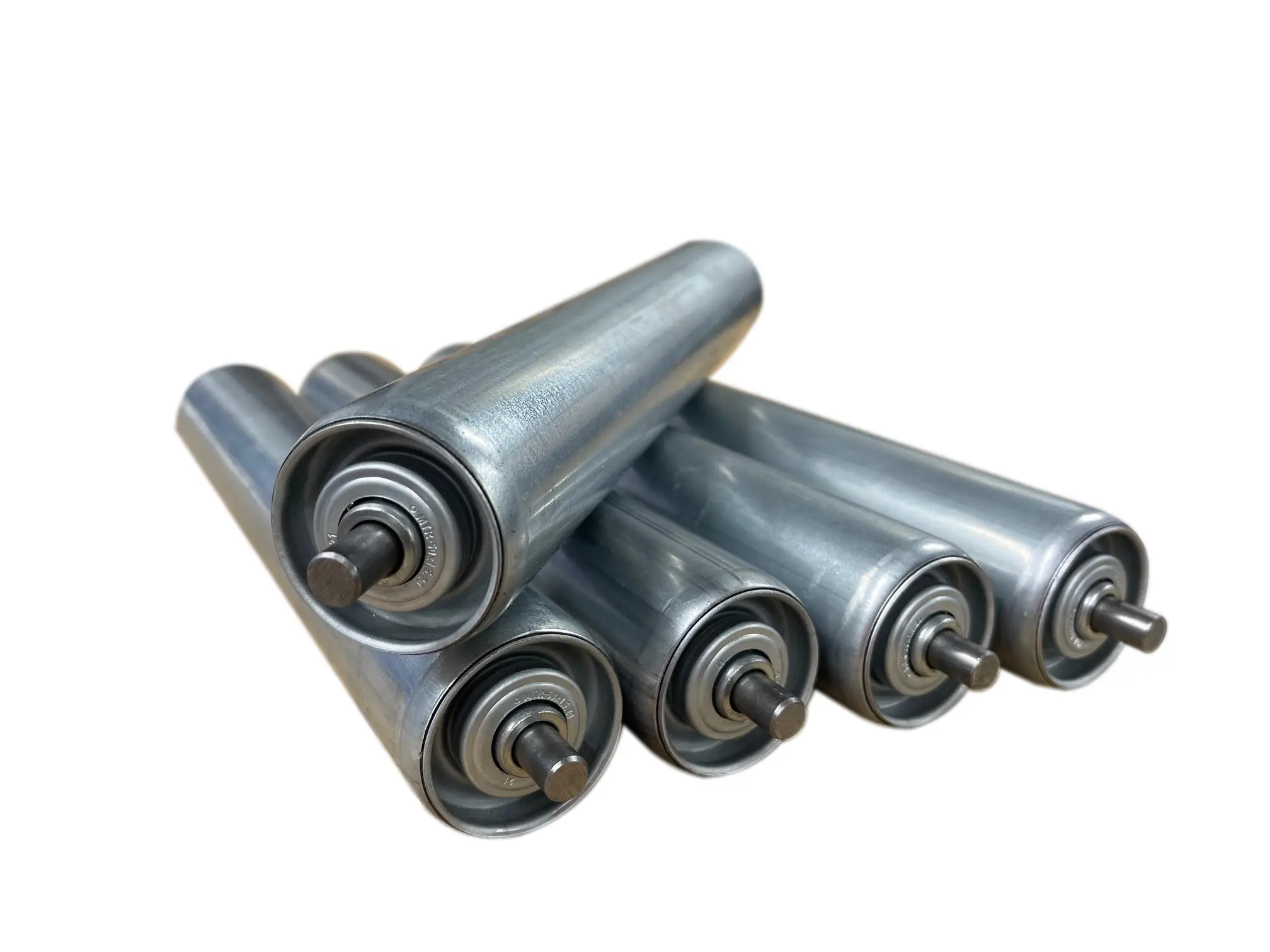
Industrial rollers are ubiquitous throughout continuous manufacturing, converting, and bulk material handling. Yet, a roller designed for a cement conveyor behaves completely differently from one handling micro-thin polyester film in a rotogravure press.
Understanding the distinction between core architectures, surface coatings, and mechanical tolerances helps plant engineers select the right equipment, prevent operational failures, and optimize production speeds.
1. Bulk Material Handling & Conveyor Rollers
Conveyor rollers (idlers) operate under heavy radial loads, abrasive particulate dust, and continuous 24/7 duty cycles.
- Troughing Idlers: Arranged in 3-roll or 5-roll frames (typically 20°, 35°, or 45°) to support the loaded belt and maximize carrying volume.
- Impact Rollers: Fitted with shock-absorbing vulcanized rubber rings at loading chutes to cushion falling rock, coal, or ore and prevent belt carcass puncture.
- Return Idlers: Support the empty return belt strand; often fitted with spiral rubber rings or polyurethane discs to shed sticky carryback material.
- Key Sealing Technology: Industrial conveyor rollers live or die by their bearing seals. High-quality idlers use multi-stage nylon labyrinth seals packed with lithium complex grease to lock out dust and moisture.
2. Vulcanized Rubber Rollers
Rubber coated rollers provide controlled surface friction, resilient compliance, and protection against web marring in printing, laminating, and textile processing.
- Nitrile (NBR) Rollers: The workhorse elastomer for offset and flexographic printing presses, resisting inks, aliphatic solvents, and fountain solutions.
- EPDM Rollers: Ideal for high-heat laminating (up to 140°C) and plastic film extrusion where ozone and polar solvents would degrade standard rubber.
- Silicone Rollers: Outstanding thermal stability up to 220°C and near-total release properties, making them indispensable for hot-melt glue applicators and heat sealing.
- Grooved Traction Rollers: Diamond knurled or herringbone grooved rubber drums used on drive pulleys to prevent belt slippage under wet conditions.
3. Cast Polyurethane (PU) Rollers
Where standard rubber shreds or wears down quickly, Cast Polyurethane (PU) rollers provide 3 to 5 times superior cut, tear, and abrasion resistance.
Key applications include metal coil processing lines, sheet metal feed pinch rolls, heavy corrugated box converting, and warehouse automated guided vehicles (AGVs). PU combines the elasticity of rubber with the load-carrying capacity of structural plastics.
4. Textile & Dyeing Process Rollers
Textile mills operate in hostile chemical environments consisting of boiling water, caustic soda, peroxide bleaching, and acid dyes. Textile rollers must satisfy two strict criteria:
- Corrosion Immunity: Manufactured from AISI 304 or 316 stainless steel to eliminate rust spots that would ruin yarn or dyed fabric.
- Micro-Smooth Finish: Precision ground with hard chrome plating (Ra < 0.2 μm) to guarantee zero snagging, thread wrapping, or fiber distortion at line speeds exceeding 400 m/min.
5. Teflon (PTFE) Non-Stick Rollers
Teflon (PTFE) coated rollers are essential wherever sticky, viscous, or molten compounds are processed. Fluoropolymers exhibit an exceptionally low coefficient of friction and withstand temperatures up to 260°C.
They are widely deployed in hot-melt adhesive coaters, sanitary napkin and diaper manufacturing lines, plastic bag sealing bars, and food packaging machinery.
6. Lightweight Aluminium Guide Rollers
On high-speed converting lines processing BOPP films, aluminum foil, or thin paper webs, roller inertia is critical. Heavy steel rolls cause web slippage, tension spikes, and scratching during acceleration and deceleration.
Aluminium guide rollers made from 6063-T6 or 6082-T6 extruded hollow tubes weigh one-third as much as steel. Fitted with low-drag deep groove ball bearings and hard-anodized surfaces (50–60 HRC), they spin freely with minimal web traction.
7. Pipe & Tube Bending Rotator Rollers
Pipe and tube rollers support and rotate heavy steel pipes during automated submerged arc welding (SAW), beveling, and CNC tube bending. They are manufactured from heavy-wall forged steel or clad with thick polyurethane to prevent steel-on-steel surface scratching on stainless and alloy pipes.
Looking for an Engineered Industrial Roller Solution?
Mishree Engineers manufactures all 10 product categories in-house at our Ahmedabad machine shop. Review our complete catalog or request an engineering quote.